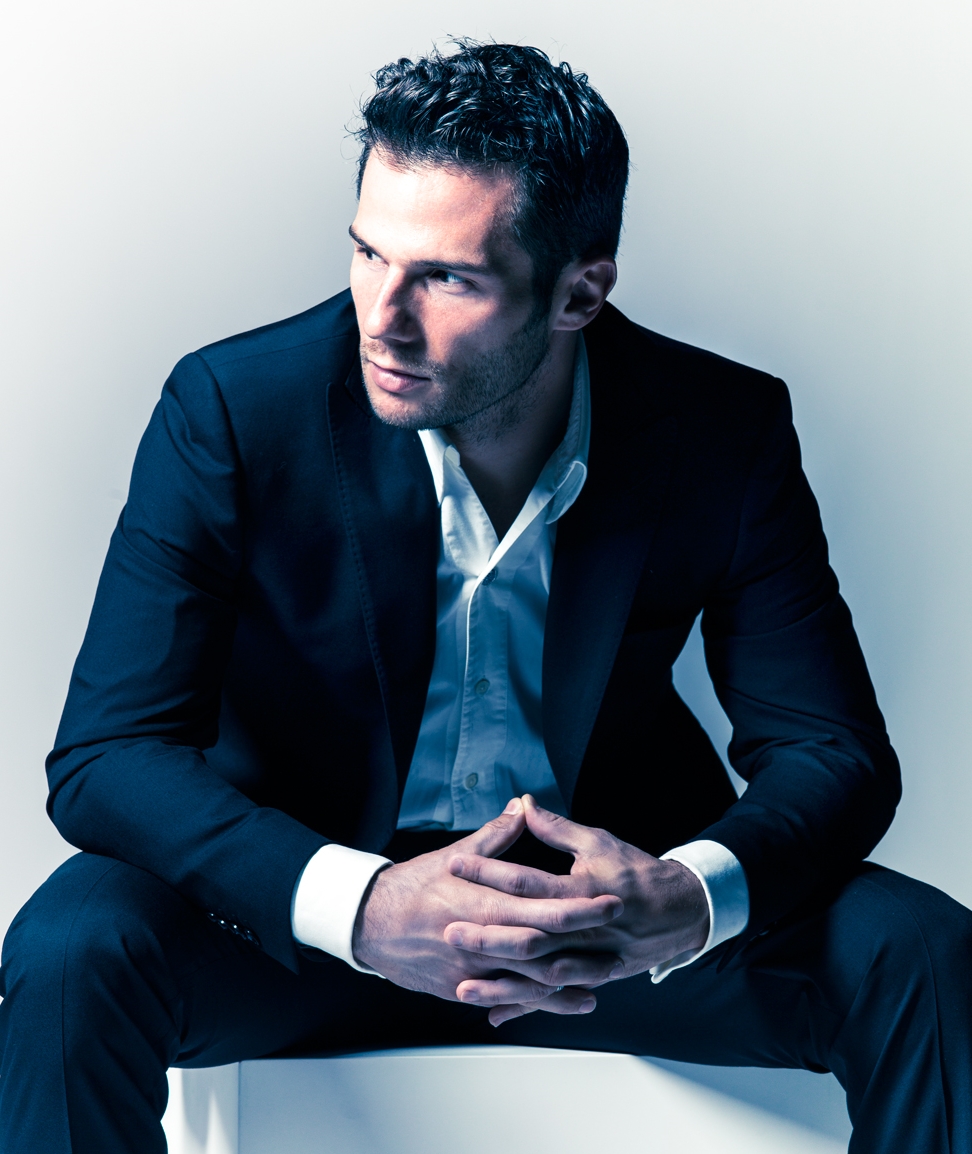
So...what's your story?
TIZIANO taught himself Mozart’s Rondo Alla Turca at twelve. It took him a month.
By then, music had already taken over his life. Born and raised in Milan, he grew up around his father’s couture atelier, where artists such as Chick Corea, Miles Davis, and Paco de Lucía moved through a world of fittings, rehearsals, backstage conversations, and music. Instruments were everywhere. So was obsession.
Piano came first, then cello, saxophone, guitar, and bass. He became obsessed not only with playing music, but understanding how it was built—arrangement, production, mixing, mastering—the architecture behind emotion.
One of the artists passing through that world was jazz legend Chick Corea, who took an interest in the young musician and became an early mentor. On one occasion, while TIZIANO was improvising at the piano, Paco de Lucía quietly picked up a guitar and began playing along—a moment that confirmed the path he already knew he was meant to follow. At thirteen, TIZIANO was photographed for L’Uomo Vogue. The sound and the image were already beginning to merge.
At fourteen, his family moved to Los Angeles. He left school and immersed himself entirely in music—practicing piano for up to ten hours a day while training his voice alone in the basement of his father’s Beverly Hills boutique, where nobody could hear him fail.
When the family returned to Italy, survival came first. He took a warehouse job at a family business, taught himself to code, built custom sales software the company didn’t know it needed, and rose from warehouse worker to general manager in less than two years. Every dollar went into building a recording studio.
For years he lived between ambition and exhaustion—working full-time by day while sneaking into recording studios at night, after sessions had ended, when sympathetic producers would quietly let him in to experiment alone on equipment he could never afford himself. It was there, during endless overnight sessions, that he began laying the foundation for the demos and production style that would later define his sound.
At the same time, he ghost-sang on Italian dance records, performed in cover bands across Italy, and obsessively chased a sound nobody around him fully understood yet: American R&B, electronic soul, atmosphere, restraint. Eventually he financed his own recording studio and flew himself to London to independently shoot his first music video. Soon after, Warner Music signed him.
The shift was immediate. MTV rotation. Top of the Pops. Performing for crowds reaching 100,000 people. But behind the sudden visibility was an artist operating with unusual creative control—writing, producing, arranging, mixing, and shaping his sound from the ground up.
As Warner began expanding his reach internationally, TIZIANO found himself pulled back toward Los Angeles—the city where his musical identity had first taken shape. The producers and songwriters he had once studied obsessively on imported CDs and during late-night studio sessions—figures like Teddy Riley, Desmond Child, Diane Warren, and Walter Afanasieff—eventually became collaborators.
Then the industry became visual. So he adapted again.
What began through directing music videos slowly evolved into photography. He approached a camera the same way he approached music: emotionally, rhythmically, obsessively. The visual instincts that surrounded him as a child—fashion ateliers, backstage runways, magazine shoots—resurfaced through a cinematic photographic style that would eventually define his second career.
Today, TIZIANO is recognized as one of Los Angeles’ leading celebrity and entertainment photographers. His work has appeared in Vogue, W, GQ, Rolling Stone, Elle, Glamour, Variety, and The Hollywood Reporter, with subjects including Sydney Sweeney, Robin Wright, Carey Mulligan, Neve Campbell, Serena Williams, Jeff Goldblum. His imagery—minimal, atmospheric, emotionally restrained—carries the same DNA as his music.
In 2025, after years behind the camera, he returned fully to recording as an independent artist. Since then, he has released a new single every two weeks—including Runaway, Big Little Lie, I Was Wrong, Fall Hard, and It Never Used to Rain in LA—writing, producing, and shaping every detail himself. The catalog unfolds less like disconnected singles and more like chapters from the same letter: intimate, cinematic, and unfiltered. For TIZIANO, music and image were never separate disciplines. Just different ways of translating emotion.
"Life is a constant journey of creative endeavors that provides me the oxygen I need to breathe. So I can stay alive."